
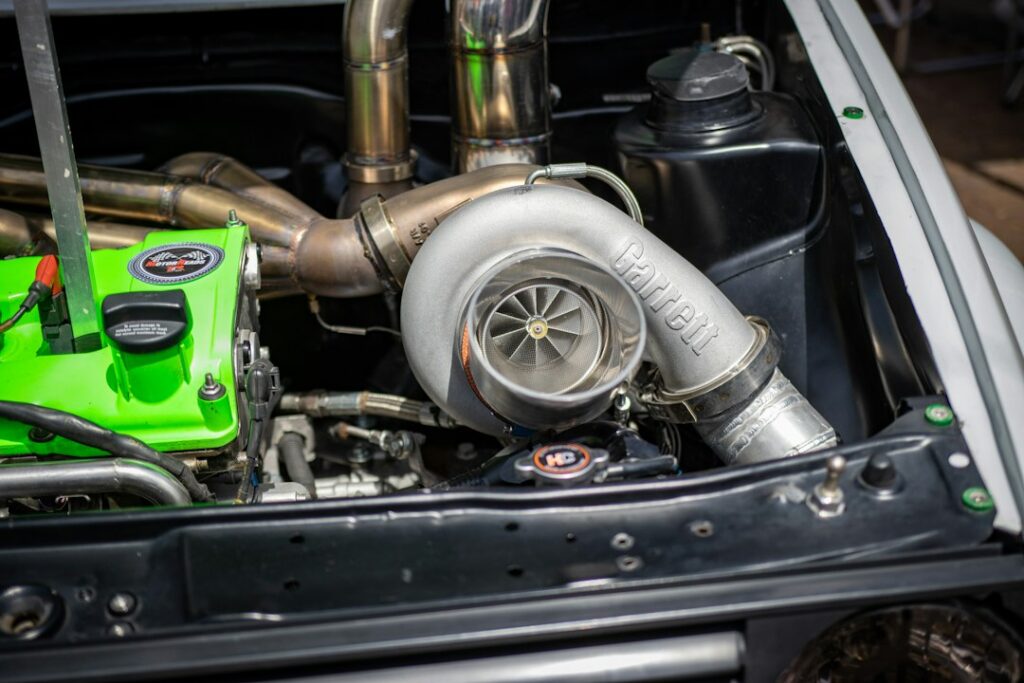

Compressor size is not a power rating by itself. A compressor map shows how a turbo moves air at different pressure ratios and flow rates, while also indicating areas where operation may be more efficient. Pressure ratio compares the pressure after compression with the pressure entering the compressor. Flow describes the amount of air the engine consumes. A small, high-revving engine might make useful street power with a G25, while an engine built to keep pulling at high rpm may better suit a G42 or larger model. Neither conclusion is valid without the engine’s actual airflow demand.
Spool is often described as though the compressor alone determines it, but turbine size, exhaust energy, cam timing, displacement, and gearing also matter. Consider a hypothetical 2.0-liter track car whose driver values acceleration out of slow corners. A larger turbo might support the desired peak output, yet a smaller G Series II could build useful boost sooner and produce a more responsive exit. On a larger engine, that same smaller turbo might reach its airflow limit as rpm climbs. The decision therefore concerns where the engine operates, not just the highest number shown in a product listing.
Turbine housing selection adds another important trade-off. The A/R ratio compares the area of the gas passage with its distance from the turbine center. A smaller A/R generally uses a tighter passage, which can support response but may increase exhaust backpressure at high flow. A larger A/R can reduce restriction and help top-end breathing, although it may soften low-rpm behavior. A hypothetical drag car that launches near its torque band may tolerate a larger housing more easily than a daily driver that must respond smoothly in ordinary traffic.
The G Series II name includes updated AERO designs and flow characteristics within the Gen 2 G-Series family, but those features do not replace application matching. Wheel design, inlet size, turbine housing, and bearing arrangement need to be considered together. Physical fit matters too. Confirm the compressor and turbine outlet dimensions, manifold pattern, downpipe position, oil lines, cooling requirements, wastegate arrangement, and available clearance before ordering. A turbo can meet a power objective on paper and still require expensive changes if the surrounding hardware cannot accept it.
Supporting parts can alter the result more than a small difference between neighboring turbo sizes. An undersized intercooler can raise charge temperature, and hotter compressed air is less dense at the same pressure. A restrictive exhaust may increase backpressure, while a poorly matched wastegate can make boost control inconsistent. For example, a hypothetical G30 installation could feel unpredictable if the manifold has poor pulse separation or the control system cannot bypass enough exhaust gas. Practical G Series II selection therefore requires checking the complete intake and exhaust path, not judging the turbo by its name alone.
Start with displacement, redline, fuel, target power, and the rpm range that matters in actual driving. Decide whether response or peak flow deserves priority, then compare turbine housing choices and examine the compressor map at expected operating points rather than relying only on a peak dyno figure. Leave reasonable headroom for real airflow, but avoid buying far more capacity than the engine can use. Use application fitment information to organize specifications, then verify the final combination with the manufacturer or an experienced installer. The practical goal is a matched system that delivers power where you can use it.